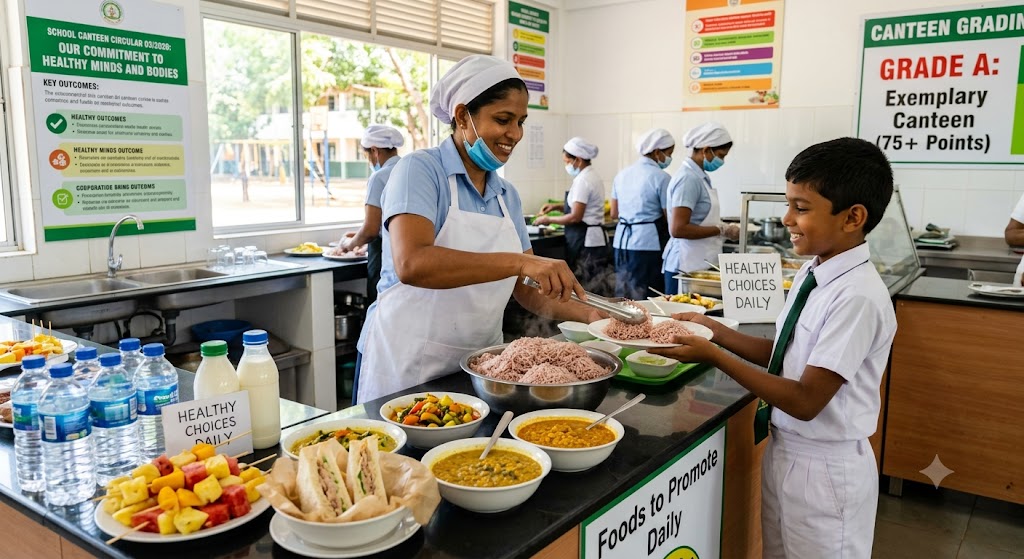
Healthy School Canteens Guidelines
The Ministry of Education has issued this circular regarding the maintenance of healthy canteens in schools. This circular supersedes the previous Circular No. 35/2015 dated 31.12.2015.
The circular highlights the importance of providing nutritious, clean and safe food to school students, promoting healthy eating habits, maintaining hygiene standards, and preventing the sale and promotion of unhealthy food items within school canteens and school premises.
Healthy School Canteens Guidelines: Circular 03/2026 | MoE Sri Lanka
| Conducted by | Ministry of Education, Higher Education and Vocational Education |
| Effective Date | February 23, 2026 (Supersedes Circular No. 35/2015) |
| Circular – English | Download PDF |
| Circular – Sinhala | Download PDF |
| Circular – Tamil | Download PDF |
| Join Whatsapp Channel | Click Here |
| Join Facebook Page | Click Here |
Expected Outcomes
- Providing nutritious and clean food to school students.
- Promoting healthy eating habits and behaviours among students.
- Increasing the percentage of students with proper nutritional status.
- Reducing the risk of non-communicable diseases among school students.
- Sharing correct eating habit messages through the school community.
Four Main Areas Mentioned
- Maintaining the school canteen and premises to the required standards.
- Proper management and supervision.
- Human resource management.
- Providing healthy and nutritious food.
Canteen and Premises Standards
- The canteen should be safe, clean, well-lit and ventilated.
- Food prices should be clearly displayed.
- Clean drinking water and hand washing facilities should be available.
- Waste bins should be covered and properly colour-coded.
- Food should be purchased, transported, stored, prepared and served hygienically.
- Expired food or ingredients should not be stored or sold.
- Cooked food and raw food should be stored separately.
Proper Management and Supervision
The circular explains that the School Development Society, Principal, School Food Committee, teachers, students, school community and education authorities are responsible for maintaining healthy school canteens.
- The School Food Committee should monitor canteen activities.
- Canteen monitoring reports should be submitted to relevant authorities.
- The committee should meet once every two months.
- Inspections and follow-up actions should be carried out regularly.
- Non-compliant canteens may be warned, corrected or closed according to instructions.
Canteen Rating According to H1306
- Grade A: Exemplary canteen – 75 points or more.
- Grade B: Conditions must be improved within 3 months – 61 to 74 points.
- Grade C: Relevant officials will take steps to close the school canteen – 60 points and below.
Human Resource Management
- Canteen staff should receive proper training and awareness.
- Medical examinations and health certification are required.
- Food handlers should maintain personal hygiene.
- Clean clothes, aprons, head coverings and face masks should be used.
- Jewellery, rings, watches and bandages should not be worn while handling food.
- Use of betel, cigarettes, alcohol or other drugs is prohibited within the canteen premises.
Foods to Promote Daily
- Rice, milk rice, pongal rice, pittu, string hoppers, hoppers and roti.
- Vegetable stew, upma, boiled pulses, vegetable curry and salads.
- Egg, tuna, vegetable sandwiches and healthy wraps.
- Fruits, fruit kebabs and mixed fruit cups without added sugar or salt.
- Chickpeas, fermented milk, low-sugar waffles and natural drinks.
- Water, fresh liquid milk, soups and fresh fruit juice with low sugar or no added salt.
Foods Prohibited in School Canteens and School Premises
- Highly processed meats and fish such as sausages, meatballs, bacon and ham.
- Fast food items such as burgers, hotdogs, submarines and pizza.
- Sugary buns, pastries, deep-fried snacks and salty chips.
- Instant noodles, soup cubes, seasoning powders and instant soups.
- Ice packs, ice palms, jellies, cakes, puddings and high-sugar desserts.
- Carbonated drinks, energy drinks, flavoured milk/yogurt drinks and artificial fruit drinks.
- Ultra-processed foods and foods with little nutritional value.